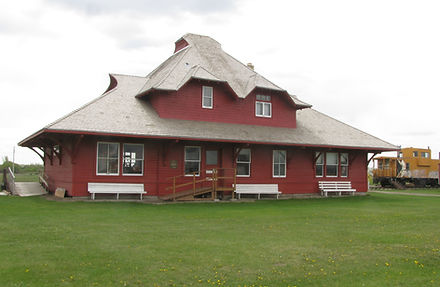
The Morden Canadian Pacific Railway train station was moved to the PTM in 1972 and later designated a heritage building circa 2008. The station was in operation until the late 1960s. The platform along the tracks has become a popular location for photos, as was the back of the caboose.
This train station, with its uncommon architectural roof line, was designed by Ralph B. Pratt in 1899. It is believed that it was built to replace an earlier station that had burned down. Construction of the station began in 1905, but was delayed until 1906 when it could be completed.
FREIGHT ROOM: The large red freight wagons were pulled through the wide loading doors and were used to load and unload luggage and other freight. Trunks would be a common container used to hold belongings of families immigrating to the area from Russia.
OFFICE: A book of original train passenger records is preserved here. In the desk drawer, there's the seal and wax for sealing envelopes stamped with the CPR logo. Two wooden mail cranes are on display. These would be held out to trains passing by so that a mailbag could be received or taken.
WAITING ROOM: The waiting room still holds its original benches, stoves, and radiator covers. The beam running the width of the room was initially meant to be a wall dividing the space into two rooms — one for women and the other for men. However, in the time between the architect’s plans and the actual construction date, plans were changed to include only one room.
STATION AGENT'S HOME: The size of the dwelling is fairly spacious for the time, as the job of the station agent was considered quite prestigious. Most of the artifacts in the home are primarily English, as the station agent for the CPR was typically an English man.
CABOOSE: The caboose was the car that marked the end of every freight train, providing the crew with minimal living quarters at the rear of the train as well as an office for the conductor. From here the crew could easily exit the train for switching. Tradition on many lines was that the caboose should be painted a bright red. Although cabooses were once used on nearly every freight train in North America, their use has declined and they are seldom seen on trains, except on local and smaller railroads.